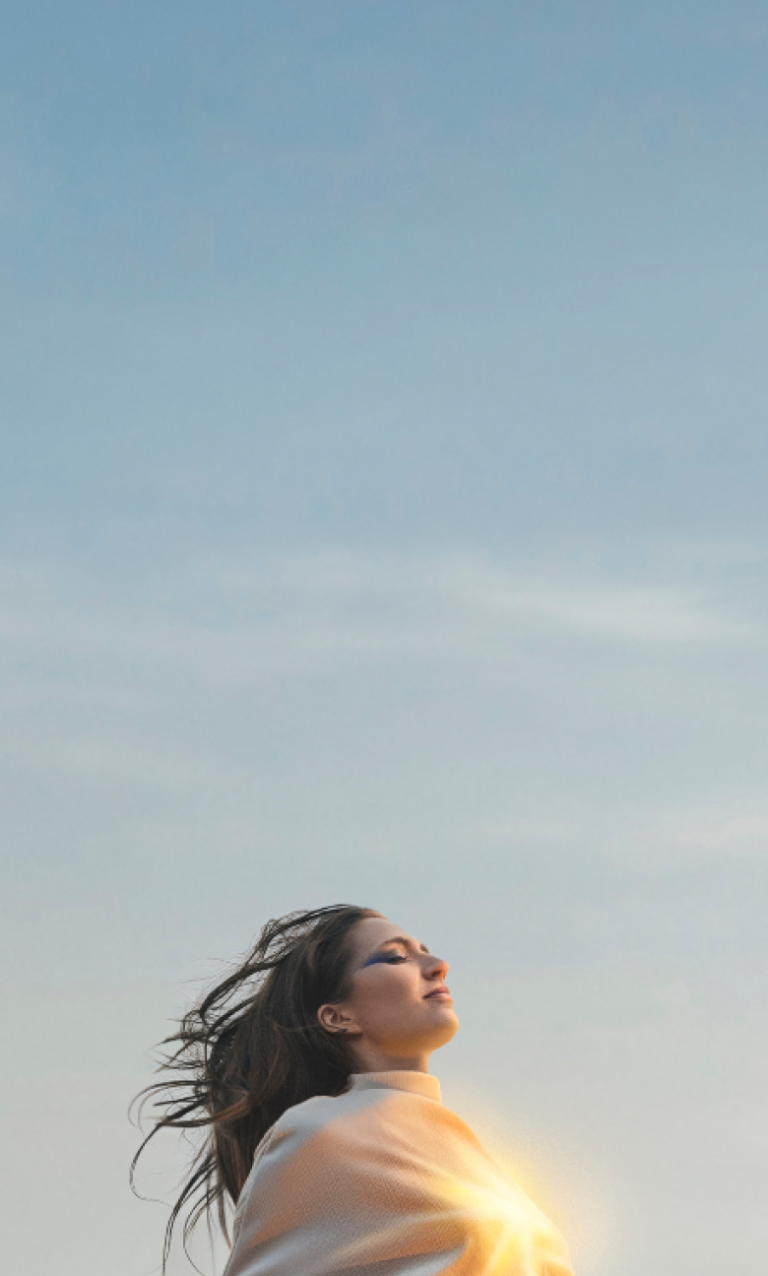
FOC2026
10, 11 and 12 July 2026
CCIB Barcelona
START AGAIN
In this edition, we lift our gaze to the cosmos to recognize ourselves as part of a whole in motion, where the immense and the minute beat with the same pulse: life is constant transformation.
Every transformation is a non‑linear process, in which we let go of parts of ourselves that, until now, have kept us inside a protective shell.
The impulse that breaks the old forms to let in the light of what is possible, to start again as an act of love and courage towards oneself, a gesture of trust in life that bursts forth and renews itself without cease. This is FOC 2026.
Every new beginning is the universe breathing through us.
“Our planet is a lonely speck in the great cosmic dark. In our darkness — in all this vastness — there is no hint that help will come from elsewhere to save us from ourselves.”
Carl Sagan
We begin by asking who we are, what it means to be a conscious being, and what boundaries define our “Self.” We question names, roles, certainties, and open ourselves to the possibility of a broader, multidimensional identity that transcends time, space, and conventional limits. We’ve learned that true progress is not born from the accumulation of answers but from the ability to dwell in doubt, to expand our vision, and to weave connections between what once seemed separate. It is from this open space — suspended between questions and possibilities, between inner life and the outer world — that we can now look toward infinity: from the Self to the Cosmos, from the small to the vast, from the intimate to the universal, and back again.
We live immersed in a universe that never ends. A universe that stretches beyond imagination, where every point of light tells an ancient story millions of years old. From the great cluster of Laniakea, to the Virgo Supercluster, to our small Local Group, to the Milky Way, the Orion Arm, the Sun, the Earth — to that fragment of crust called Spain, Catalonia, Barcelona — everything moves, breathes, changes. Our galaxy, a disc a hundred thousand light-years wide, is but a drop of water in an ocean of stars. And our solar system, in thirteen billion years, has completed only six orbits around the galactic center. Six solar revolutions in the eternity of the cosmos.
“You are the universe in motion, disguised as a person for a moment.”
Rumi
Yet what happens in the vast also unfolds in the minute. The same spirals, fractals, and geometries that trace galaxies can be found in the orbits of particles. As above, so below. As within, so without. The same harmony repeats at every level of existence.
And we stand in the middle: between the infinitely large and the infinitely small, between galaxy and atom, between certainty and mystery. In this fragile balance, in this in-between place, lies all our strength — and all our unrest.
To be in the middle is to be ready for movement, to welcome change when it appears, to choose to flow with life without being passively carried. It is the awareness that motion is born of participation — the choice to inhabit each moment with openness and presence. Yet often, this movement, for the human being, takes the name of difficulty.
“The cave you fear to enter holds the treasure you seek.”
Joseph Campbell
Difficulties are not accidents along the path — they are part of the natural rhythm of things. Every problem is like a gravitational field pulling us toward a new center; but if we learn to shift our gaze, every obstacle becomes a threshold, a passage through which life renews itself.
To inhabit it does not mean to erase tension, but to learn to dance with it.
Every limit, physical or mental, is born to define — yet often ends up dominating. And when that happens, we lose our certainties and seek outside ourselves for those who promise to restore them. Thus arise the powers that offer easy truths, instant answers, comfort in exchange for freedom.
But true freedom is to remain in doubt — to remain open.
Race, gender, nationality, ideology, ability — these are human constructions. In nature, there are no categories, only transformations. Life changes form and yet remains itself; it preserves and renews itself in the same gesture. To accept impermanence is to understand that everything flows, and that stability is a necessary but momentary illusion. To accept not having all the answers may create an existential void we try to fill daily without noticing — but perhaps that very void is contemporary wisdom.
For it is in the void that imagination blooms.
“He who does not dare to dissent will never be free.”
Albert Camus
New ideas are always born on the edges, in the open spaces, beyond established rules; this is why every creative act is also an act of disobedience.
From here arises disobedience — not as destruction, but as a vital impulse that pushes us beyond the horizon of the known.
To disobey is to recognize that every truth is but a step along the way, that every form, however precious, is destined to transform. The mother form, which has sustained life until that point, must evolve and yield to the daughter form — new, unexpected. It must “die,” let go, withdraw, so that life may expand, so that something larger, something different, something never before existing may be born. It is the moment when life refuses to become static and returns to flow — to question, to transformation.
To disobey is to open a space where thought can breathe — where creation serves not the rule, but the possible. The one who disobeys does not break to destroy, but to let light in. To transgress, then, is not rejection — it is an act of love toward the future, a declaration of trust in humanity’s ability to imagine more, to imagine beyond.
It is saying yes to life — against fear.
It is to accept that freedom is not inherited — it is invented, each time from zero.
We were taught to die, to resign, to stop searching.
But the greatest task is to learn to be reborn.
To begin again after every failure, after every fear.
Because every ending is only a beginning not yet revealed.
Do the thing you fear.
Begin again.
It’s not a mistake; it’s a sign that you’re alive.
And so, choose to begin again.
Begin again from love.
Begin again from yourself,
from your shadows and your edges,
for it is there that light finds its path.
Begin again from your essence,
from your belonging to the vast design of things.
Begin again from courage,
even trembling, even falling.
Begin again from humility,
recognizing you are part, not center.
Begin again from the other,
from the face that reminds you you exist —
your brother, your sister, yourself.
Begin again from humanity,
from the tenderness that still breathes among the ruins,
giving voice to the unheard,
hands that build amid pain.
Begin again from the cosmos,
from silence,
from dream,
from imagination
that breaks the limits of the possible.
Begin again to choose, each day.
Begin again to live,
with the wonder of one who sees anew.
Begin again to create: living realities, possible worlds.
Begin again, once more.
And again.
And again.
To choose is the purest gesture of freedom.
It is the moment when the universe, through you, learns once more to begin.
FAQ\\\\\\\\\\\\\\\'s
Where and when will it take place?
On January 9 and 10, 2027, at Proyectos Públicos – General Prim 30, Mexico City.
Do I have to contribute to attend?
No. You don’t need to make any payment to save your spot. Your registration and your experience at the festival are never conditional on making a contribution. Giving is entirely voluntary. Some people may not be able to contribute financially, but give their time and energy as volunteers. Others may be able to contribute enough to help cover the cost for several attendees, making the festival more accessible to people who cannot contribute financially.
Why isn’t there an admission fee?
Because many people and organizations have contributed their time, knowledge, resources and support to make a festival open to everyone, regardless of their financial circumstances. FOC is a social and economic experiment in generosity and gratitude, built collectively by everyone who takes part. Its very existence shows that another kind of economy is possible, and that money is not the only way to measure the value of something.
Why is it held in a city like Mexico City?
In an accelerated and fragmented world, we need spaces where consciousness can become a driving force for collective change. Over the past few years, FOC Barcelona has built strong connections with Mexico through an active volunteer community in Mexico City, as well as Mexican and Latin American speakers who have taken part in previous editions, and the commitment of European and American leaders to join this edition.
Mexico City, with its diversity, creativity, and 22 million inhabitants, is the ideal epicentre to start this conversation.
After Barcelona, FOC arrives in Mexico not only to share, but also to listen, learn, and discover everything that can emerge from this encounter.
What language will it be in?
All talks and activities will be in the speaker’s native language (usually Spanish or English). Some spaces will offer simultaneous translation. The translation will be automatically generated and dubbed over audio, not subtitled. The final schedule will indicate the language of each activity and whether simultaneous translation is available.
Who is the Festival for?
The Festival is diverse and inclusive, connecting with people from all walks of life. It becomes a beautiful blend of genders, ages, cultures, backgrounds, beliefs, and professions.
We believe that the expansion of human consciousness must be a transversal phenomenon and never restricted to specific groups.
Can minors attend?
Yes, as long as they are accompanied by an adult. Like all attendees, they need their own pre-registration: you can make it in their name using your email address.
Some activities will be for ages 16 and over only: these will be marked in the program.
How to get there

Bus
Lines: H16, V29, V31, V33, 7, 136, B20, B23
Every day: de 6:30 am to 23:15 pm

Tram
TRAM (Line T4): Fòrum and Maresme stops
Monday to Thursday: 5:00 am to 12:00 am
Fridays, Saturdays, and holiday eves: 5:00 am to 2:00 am
undays and holidays: 5:00 am to 12:00 am

Metro
L4 – EL MARESME-FÒRUM STATION (EXIT RAMBLA PRIM)
The festival venue is just 150 meters away
L4 – SELVA DE MAR STATION
Hours:
Monday to Thursday: 5:00 am to 12:00 am
Fridays and holiday eves: 5:00 am to 2:00 am
Saturday: continuous service
Sunday: 5:00 am to 12:00 am

Bicycles
BICYCLES PARKING
Available at Plaza Leonardo da Vinci.
Free service, subject to capacity. Users must bring their own lock.
BICING
Nearest stations (within a 500-meter radius of the festival exits):
(35) C/ Sant Ramon de Penyafort, 1
(67) C/ Josep Pla, 67
(157) C/ Llull, 451
(158) Rambla Prim, 19
(159) Avda. Diagonal, 26
(160) Avda. d’Eduard Maristany, 1/ Fòrum
(168) Selva de Mar/Pssg. Taulat
(178) Pssg. Garcia Fària, 85
(451) C/ Pallars, 504